Platform Overview & Operational Mandate
Architectural purpose, core capabilities, and structural comparison between AetherKube and conventional dashboard tooling.
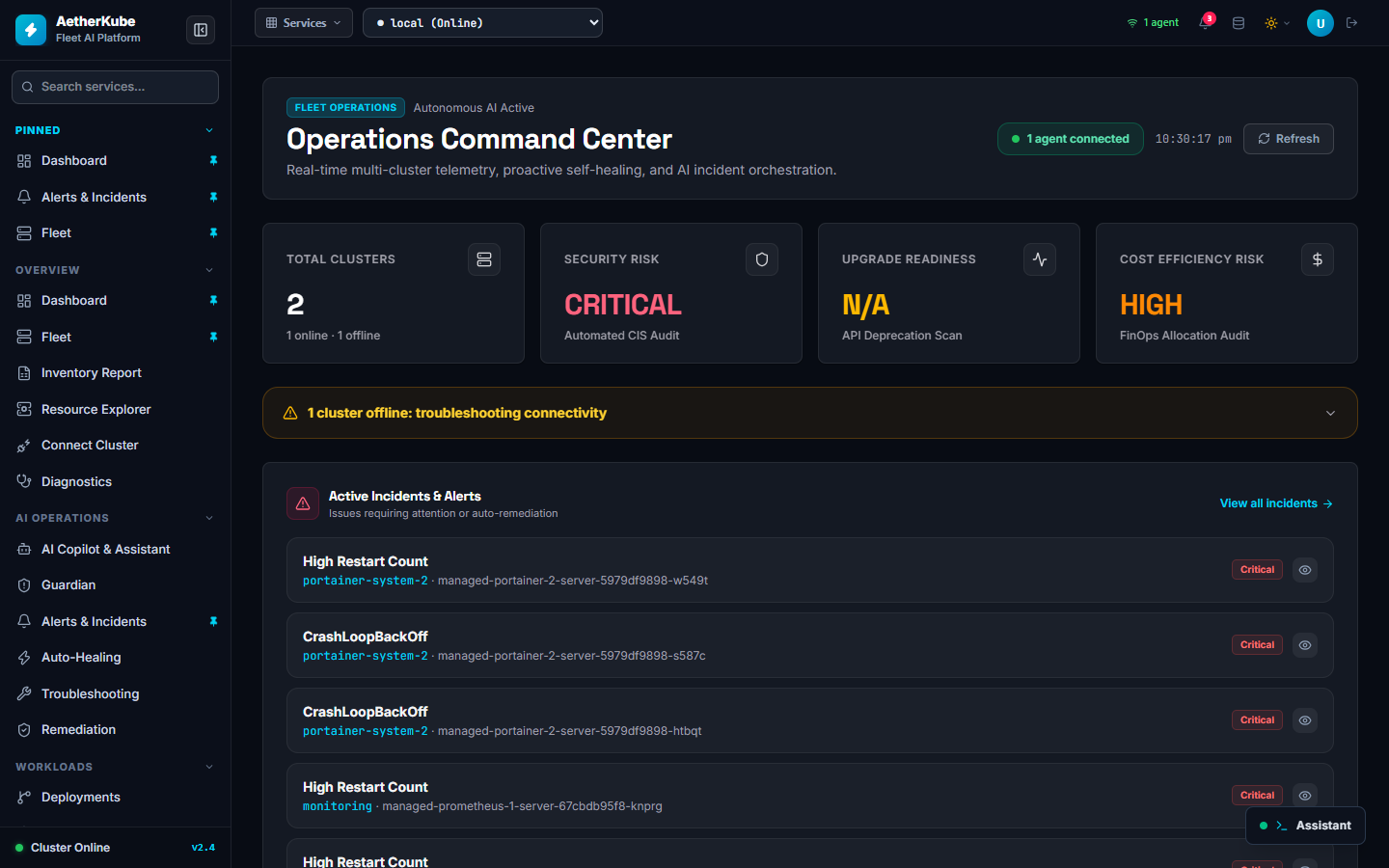
AetherKube is an autonomous Kubernetes operations, observability, and self-healing control plane engineered for Platform Engineers, Site Reliability Engineers (SREs), and Cloud Operators.
Traditional Kubernetes management platforms are purely passive: they scrape metrics into dashboards and generate notifications when thresholds trigger, leaving manual diagnosis and mitigation to on-call humans. AetherKube inverts this paradigm by acting as an autonomous in-cluster platform engineer.
### Architectural Tenets
1. Outbound-Only Tunneling: Managed clusters never expose inbound firewall ports or load-balancer ports. The local agent maintains a persistent, mutual-TLS authenticated WebSocket outbound connection to the hub.
2. Deterministic & LLM Dual Engine: Core operational guardrails operate deterministically with zero token costs and zero latency. For complex root-cause reasoning, platform operators can optionally enable local (Ollama) or frontier cloud models (Claude, OpenAI, Gemini).
3. Non-Destructive Self-Healing: Every automated remediation action operates under configurable cooldown windows, strict blast-radius boundaries, and immutable audit logs.
4. Heterogeneous Fleet Abstraction: Identical operational workflows apply across local developer clusters (Docker Desktop, Kind, Minikube) and enterprise clouds (Amazon EKS, Azure AKS, Google GKE, Bare-Metal K3s).
Configuration & CLI Reference
[Unit]
Description=AetherKube Fleet Telemetry & Self-Healing Agent
After=network.target kubelet.service

[Service]
Type=simple
User=aetherkube
ExecStart=/usr/local/bin/aetherkube-agent \
  --endpoint="wss://hub.aetherkube.io/v1/telemetry" \
  --cluster-id="production-us-east-1" \
  --log-level="info"
Restart=always
RestartSec=5s

[Install]
WantedBy=multi-user.target